Guide to Money & Banking: Paying for Stuff in Lake Chapala
- Michaela & Ricardo

- 11 minutes ago
- 5 min read
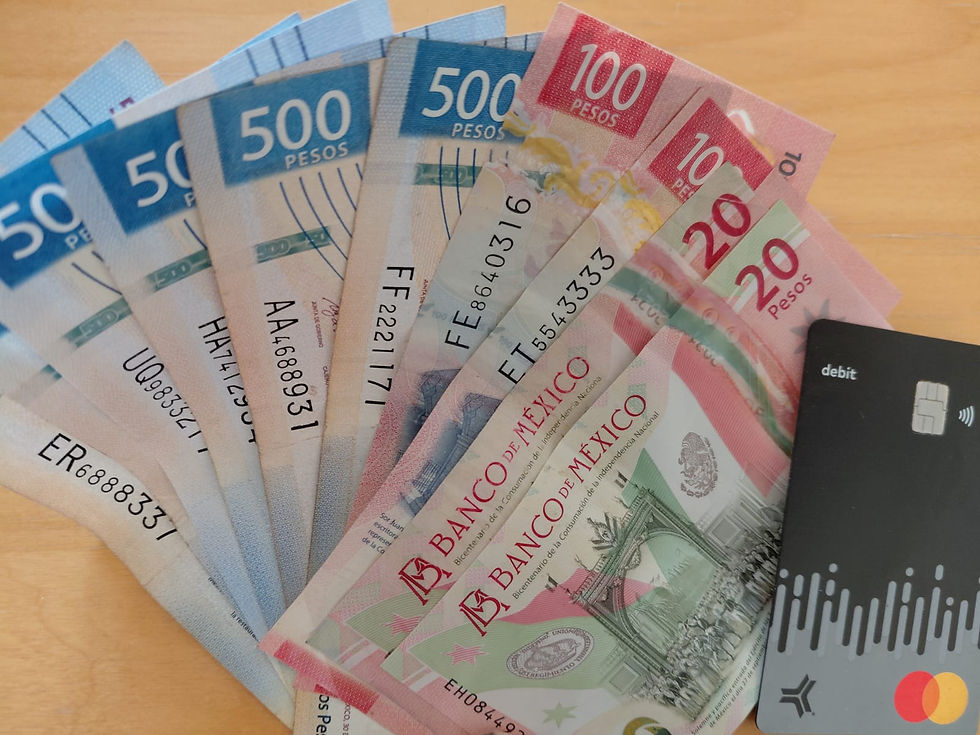
Many visitors to Lake Chapala who are used to paying for their groceries or restaurant meals with credit cards are totally surprised to discover that in many places, card payments are still not accepted.
There are exceptions, of course, like Walmart or the larger liquor stores such as La Paz or Vinos Americas, but in general, this is a cash society. If you are planning a trip or a permanent move, understanding how to buy and pay for things in Lake Chapala, Mexico, will save you a lot of frustration.
Cash is King: Navigating Mexican ATMs and Banks
For starters, if you are visiting as a tourist, be sure to bring your debit card. There are plenty of ATM machines available throughout the Lakeside area, although you should anticipate times—particularly during major holidays—when the machines completely run out of cash.
Opening a Peso Bank Account
Once you live here under a temporary or permanent visa, you can open a local peso bank account to manage your day-to-day bills, rent, and living expenses.
Once you select a bank and open your account, keep in mind that the amount of money you can withdraw at one time will vary:
ATMs: Typically dispense between 5,000 to 8,000 pesos per day.
Bank Tellers: You can usually receive up to 50,000 pesos without ordering the cash a day prior.
Why the limits? Banks only bring in a specific amount of cash per day to keep their theft insurance costs down. They calculate exactly what they expect to release that morning, meaning daily liquidity can be tight.
Paying with Cards in the Lakeside Area
Paying by Debit Card
Every local bank will provide you with a debit card for your account. Fortunately, debit is widely accepted at most established businesses across the Lake Chapala region, making it an easy and safe way to pay without carrying thick rolls of cash.
Paying by Credit Card
As we all know, credit card companies charge businesses a transaction fee every time a card is swiped. In many cases throughout Mexico, this fee—approximately 3% to 4%—is passed directly to the customer if they want to use a credit card.
Because of this extra cost, only about 40% to 50% of businesses in the Lake Chapala area currently accept credit cards, though this number has been increasing as of late. If you venture into bigger towns and major cities in Mexico, you will find credit card usage to be much more common.
Modern Payment Alternatives in Mexico
Paying by Direct Deposit via OXXO
Recently, I needed a new car tire. Since I wasn't happy with the prices I was quoted locally at Lakeside, I started shopping on Mercado Libre, a hugely popular internet marketplace in Mexico. I found the exact tire at a 600-peso savings and ordered it.
To pay for it, I used OXXO. This massive convenience store chain accepts cash payments on behalf of countless businesses, including giants like Amazon Mexico, Mercado Libre, cellular providers, and the electric company.
The process is incredibly simple:
Complete your order online and select the cash/OXXO payment option.
Bring the provided "request number" or barcode to the OXXO teller.
Pay the teller in cash. All the information is already linked in their system, and the payment is instantly credited directly into the seller’s business account.
This system exists because a significant portion of the population in Mexico does not have a formal bank account, making convenience store cash deposits the primary driver of e-commerce.
Paying by Domestic Wire Transfer (SPEI)
For large transactions (typically amounts greater than 50,000 to 100,000 pesos), cash and debit are no longer practical. For instance, when we recently needed to pay a contractor hired for a special project on the site of our new house, we used a domestic wire transfer, known locally as a SPEI.
A SPEI transfer costs just 10 pesos plus 16% IVA tax. To execute one, you will sit down with a bank associate and provide:
The payee’s official name and account information.
The 18-digit CLABE number (the standard Mexican banking code) or the SWIFT number of the receiving bank.
The whole process takes about 10 to 15 minutes, requires your confirmation signature, and is fully traceable and safe.
Wrap Up: A Personal Lesson in Mexican Banking
Discounts are frequently offered by local businesses if you pay in cash. Because of this, having access to larger sums of money is highly beneficial when you are managing a project or buying furniture.
Planning ahead is key to avoiding disappointments, but you still need to remain flexible and accept "what is"—such as days without any cash at the teller simply because the armored money truck did not arrive on time.
A Lesson in Kindness at the Bank
Case in point: on a recent shopping trip to Guadalajara, my partner and I found some beautiful tiles we wanted to buy for our new home. The deal was strictly "cash only," and the sale price was only valid until the next day, Friday.
First thing Friday morning, we hurried to our bank to withdraw a large amount of cash. To our dismay, the teller refused us, explaining that they could only release half of the amount we requested because their vault was running low on funds for the day.
As we were walking out disappointed with only half the money, our bank manager happened to overhear the transaction. Recognizing us, he intervened and managed to authorize the full withdrawal instead of the suggested half. Needless to say, we were incredibly grateful for his attention!
The moral of the story? Always be genuinely nice and kind to everyone, especially the bank tellers and managers. In the 14 years I’ve lived in Lake Chapala, I have learned over and over again that local people will do everything possible to accommodate your requests. The least we can do is smile, be pleasant, and remain patient—and on occasion, gracefully accept when they are simply unable to help.
Get all the information you need on moving to Lake Chapala! Whether you are a first time visitor or seriously considering relocating to Lake Chapala, this book is for you!
Buy Now on Amazon Kindle!

Don't have Kindle? Contact us for a PDF version
Email: heckertricardo@gmail.com
Ricardo, Michaela, Katie & Minna are your FULL SERVICE Real Estate Agents and Relocation Specialists.
Along with our network of area Professionals, we help guide you in your Retirement Journey to Lake Chapala, Mexico.


Comments